

We often try to understand ourselves by thinking harder. We replay conversations. We name feelings. We search for reasons. Still, something stays unclear. The body usually knows why.
Somatic journaling is the practice of writing from body awareness, not just from thought.
Instead of asking only, “What happened today?”, we also ask, “What did my chest do when that happened?” or “Where did I feel pressure, warmth, restlessness, or collapse?” This small shift changes the quality of reflection. We stop treating the body as background noise and start seeing it as part of the truth.
In our experience, many people notice body signals long before they can explain them. A tight jaw may appear before anger is admitted. A heavy stomach may show up before fear gets words. A sudden urge to leave a room may come before the mind accepts discomfort. The body speaks early. It speaks plainly. We just do not always listen.
The body often tells the story first.
Somatic journaling gives that story a page. It helps us connect sensation, emotion, memory, and choice in one place. This matters for self-reflection because we are not only thinkers. We are lived beings, and our inner life leaves traces in posture, breath, tension, movement, and impulse.
Why body cues matter
Body cues are not random details. They are part of how we register life. Fast breathing, numb hands, warmth in the face, a sinking chest, shaky legs, a sense of expansion, all these can reveal how an event is landing inside us.
A review from the University of California San Francisco on body awareness measures pointed out how broad and meaningful this field is, while also showing that measuring body awareness in a full way is not simple. We think that is useful to keep in mind. Body awareness is real, but it is not mechanical. It asks for attention, honesty, and context.
When we journal with body cues, we begin to notice patterns such as:
- Which situations create contraction or ease
- How different emotions feel in different body areas
- What happens in the body before people-pleasing or withdrawal
- How the body reacts to certain names, places, and memories
This does not mean that every sensation has one fixed meaning. A tight chest can signal grief, stress, shame, or even excitement. What matters is the pattern in our own lived experience.
How somatic journaling works in practice
Somatic journaling is simple, but not always easy. We are used to writing from the head. The body asks for slowness. It asks us to pause long enough to notice what is happening now.
A basic entry can start with three short observations:
What happened?
What do I feel in my body?
What emotion or need might be connected to that?
For example, we might write: “I got a message from a family member. My shoulders rose. My stomach felt hard. I wanted to postpone answering. I think I felt pressure and resentment.” This is already rich material. It goes beyond opinion. It includes direct experience.
The goal is not to interpret fast, but to notice clearly.
Sometimes a short entry is enough. At other times, one sensation opens a deeper memory. We may write about a numb throat and suddenly recall years of holding back words. We may notice trembling in the hands and connect it to fear of conflict. The page becomes a place where body memory and conscious reflection meet.

Prompts that help us listen better
Blank pages can feel too open. A few grounded prompts can make body-based reflection easier and safer. We prefer prompts that stay concrete.
- Where in my body do I feel the strongest signal right now?
- Does this sensation feel tight, warm, cold, heavy, hollow, sharp, or restless?
- When did this sensation begin?
- What happened right before it changed?
- If this body area could speak, what would it say?
- What does this part of me seem to need?
There is something honest about writing, “My chest feels crowded,” before writing, “I think I am sad.” The sensation gives us a doorway. The label may come later.
We have also seen how useful it is to track change over time. A sensation that first appears as panic may soften into grief after ten minutes of careful writing. Another may stay strong, which can be a sign that more rest, support, or boundaries are needed.
Body awareness and self-image
Somatic journaling is not only for stress. It can also change how we relate to ourselves. When we become more aware of inner signals, we often become less trapped in outer appearance and performance.
Research from Royal Holloway University of London on interoceptive awareness and self-objectification found a negative correlation between heartbeat perception and self-objectification in women. In simple terms, greater contact with inner bodily signals was linked with less self-objectification. We find this deeply meaningful. When attention returns inward, self-contact can become more real than self-display.
Listening to the body can shift us from appearance to presence.
This is one reason somatic journaling can feel unexpectedly grounding. It brings us back from image to experience. From performance to contact. From “How do I seem?” to “What is true in me right now?”
What to do when strong feelings appear
Sometimes body-based writing opens more than we expected. A sensation can bring up grief, fear, anger, or old memories. This is not failure. It means the body is no longer being ignored.
Still, we need care. We do not have to push through every feeling at once. If writing becomes too intense, we can slow down and return to simple orientation:
- Feel both feet on the floor
- Look around the room and name five objects
- Lengthen the exhale without forcing it
- Pause the writing and place a hand on the body area that feels most activated
There was a day when one of us sat down to write about irritation after work and found, under that irritation, a wave of sadness. Not dramatic sadness. Quiet sadness. The kind that hides behind busyness. The body had been carrying it in the throat all day. Once named, it softened. That is often how this practice works. Not by making life perfect, but by making experience more conscious.
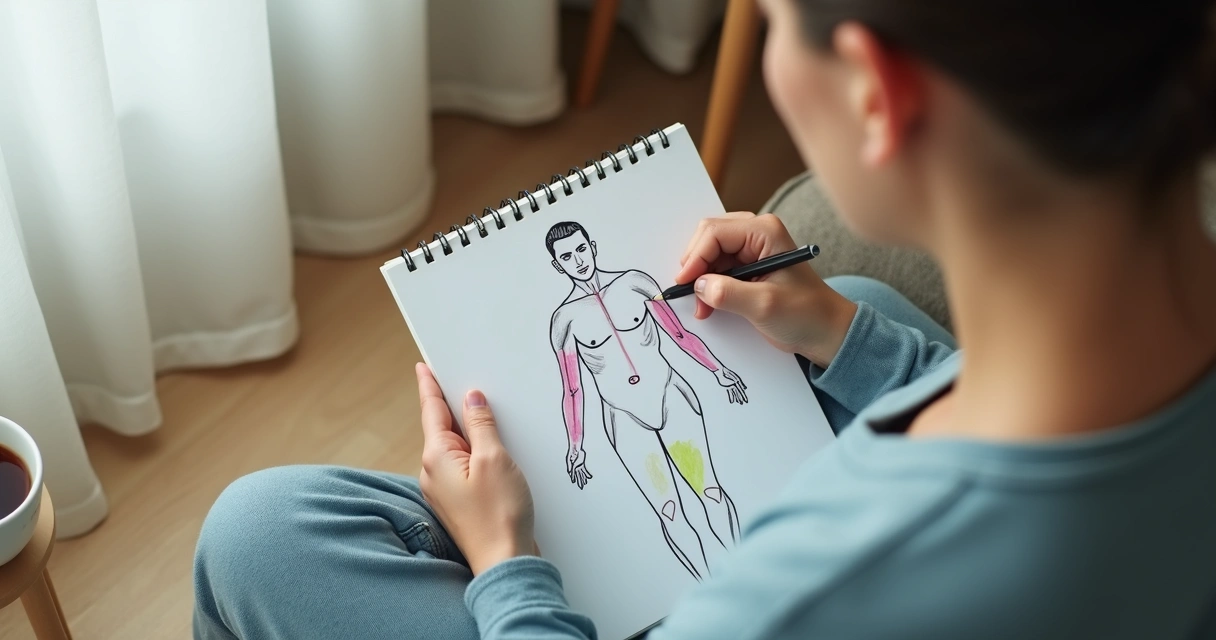
Making it part of life
Somatic journaling works best when it becomes regular enough to reveal patterns. It does not need to take long. Five to ten minutes can be enough if we are honest and present.
We suggest keeping the practice simple:
- Choose one time of day when the body is easier to hear
- Write by hand if possible, since it often slows thought
- Use the same few prompts for two weeks
- Read old entries only after some distance, so patterns stand out
The point is not perfect insight every day. Some entries will feel flat. Some will be striking. Over time, we begin to recognize our signals earlier. That can change how we speak, rest, set limits, and respond to others.
Conclusion
Somatic journaling helps us reflect with the whole of our experience, not only with our thoughts. When we include body cues in writing, we gain access to reactions that are often faster and more honest than our explanations. Tension, warmth, numbness, breath, posture, and impulse all become part of self-knowledge.
Self-reflection becomes deeper when the body is allowed to speak.
Used with patience, this practice can help us name emotions more clearly, notice patterns sooner, and make choices with more presence. We do not need a perfect method. We need attention, language, and the willingness to stay close to what is real.
Frequently asked questions
What is somatic journaling?
Somatic journaling is a form of reflective writing that focuses on body sensations as part of inner awareness. Instead of writing only about events or thoughts, we also write about cues like tightness, warmth, pressure, shaking, numbness, or changes in breathing. This helps connect the body, emotions, and personal patterns.
How do I start somatic journaling?
We can start with a quiet moment and a simple prompt. First, pause and notice one body sensation. Then write what happened, where you feel it, how it feels, and what emotion may be linked to it. Keep it short at first. A few honest lines are enough to begin.
What are the benefits of somatic journaling?
Somatic journaling can improve body awareness, emotional clarity, and pattern recognition. It may help us notice stress sooner, understand reactions with more depth, and respond with more care instead of staying on autopilot. It also supports a more grounded and present form of self-reflection.
Is somatic journaling good for anxiety?
It can be helpful for anxiety because it teaches us to notice early body signs such as shallow breathing, tight muscles, or restlessness. Writing these cues down may create more space between sensation and reaction. Still, if anxiety feels overwhelming, it is wise to keep the practice gentle and seek added support when needed.
How often should I practice somatic journaling?
A few times a week is enough for many people, though daily practice can also work well if it stays simple. We think consistency matters more than length. Even five minutes of honest body-based writing can reveal patterns over time.