
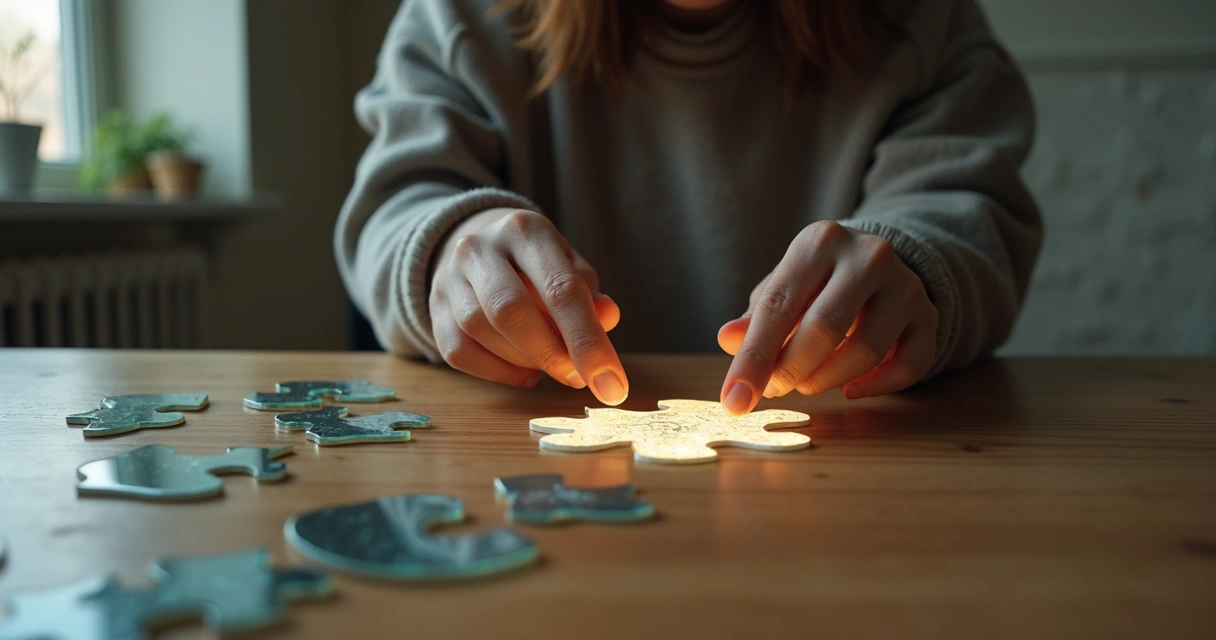
We often meet people who say, “I do not feel like the same person in different parts of my life.” We may have said it ourselves. At work, we act one way. At home, another. In conflict, we become someone we barely recognize. This does not always mean dishonesty. Sometimes it points to fragmentation.
Fragmentation happens when parts of our inner life stop talking to each other.
It can look subtle at first. We make choices that do not match our values. We react strongly, then feel confused by our own reaction. We want closeness, yet we push people away. We keep going, but with an odd sense of inner split.
In our view, fragmentation is not a moral failure. It is often a way the person tried to adapt, protect pain, or survive pressure. A child learns to hide fear. A teenager builds a social mask. An adult keeps moving, but the old divisions remain active.
What is divided seeks connection.
This is why self-knowledge matters. Not as a collection of labels, but as a process of becoming more whole. When we can see our parts without panic, we begin to regain coherence.
What fragmentation looks like
Fragmentation does not always appear dramatic. Many people function well on the outside while feeling disconnected on the inside. We may look calm and capable, yet feel scattered, numb, or internally at war.
A classic sign is inconsistency that brings suffering. We are not talking about healthy flexibility. We mean repeated shifts that leave us feeling false, lost, or exhausted. Research on self-concept differentiation and emotional adjustment found that greater inner division was linked with poorer emotional adjustment and more depressive symptoms. That supports the idea that fragmentation is not just normal role variety.
In daily life, fragmentation may show up in several ways:
We say yes when we mean no, then feel resentment later.
We present confidence in public but collapse in private.
We keep changing our priorities depending on who is in front of us.
We feel cut off from our body, emotions, or deeper motives.
We tell different stories about ourselves and cannot join them into one truth.
These signs do not prove a disorder. They do suggest inner material that has not yet been integrated.
Why fragmentation develops
People rarely divide inside for no reason. Usually, fragmentation begins as adaptation. A person learns that one emotion is welcome and another is dangerous. One version of the self receives love, while another is ignored, corrected, or shamed.
We have seen this in simple moments. Someone grows up hearing, “Do not be difficult.” Years later, anger becomes hard to feel directly. It does not disappear. It leaks out as sarcasm, withdrawal, or headaches. Another person learns that being needy brings rejection. As an adult, they pride themselves on independence, yet quietly long for care.
What we do not integrate does not vanish. It keeps acting from the background.
Culture also shapes this process. A meta-analytic review on the divided self and maladjustment found that higher self-concept differentiation was generally linked with psychological maladjustment, with stronger effects in more individualistic settings. This suggests that being split across contexts can carry a real emotional cost.

Signs that ask for attention
Not every contradiction means fragmentation. Human beings are complex. Still, some patterns deserve close attention because they repeat and drain our inner stability.
We would watch for these signs:
Emotional lag. We only understand what we felt hours or days after the event.
Role dependence. Our identity changes too much depending on the setting.
Inner blanks. We struggle to explain why we made a choice or reacted so strongly.
Chronic self-betrayal. We repeatedly go against what we know matters to us.
Relational confusion. We want honesty, but we hide. We want peace, but we provoke conflict.
One woman once described it in a simple way: “Every room gets a different version of me, and none of them feel fully true.” That sentence says a lot. Fragmentation often feels like living in pieces, without a stable center that can hold them together.
Tools that support integration
Integration is not forced unity. We do not erase parts of ourselves. We help them come into relationship. The goal is not perfection. It is contact, honesty, and inner order.
Some tools help more than others because they slow us down enough to notice what is happening.
First, naming experience matters. When we can say, “Part of me wants approval, and part of me feels angry,” we stop collapsing everything into one blur. This creates room for awareness.
Second, body attention helps. Fragmentation often lives in disconnection from physical signals. Tight chest, clenched jaw, frozen stomach, heavy shoulders. The body usually knows before the mind explains.
Third, reflective writing can reveal repeated splits. We may notice that the same conflict returns with different faces. We want to please, then feel trapped. We seek closeness, then pull away. Patterns become visible when written over time.
These practices can support the process:
Pause after strong reactions and ask what was threatened.
Write two or three voices present in the same conflict.
Track bodily sensations before explaining the story.
Compare our choices with our stated values each week.
Speak honestly with one trusted person instead of performing control.
None of this gives instant relief. But it builds continuity. And continuity matters.
Integration begins with truthful noticing.
What integration changes
As integration grows, we do not become flat or rigid. We become more coherent. Different parts of the self can exist without taking turns in secret. Strength no longer needs to deny vulnerability. Care no longer needs to hide anger. Limits no longer cancel love.
In our experience, one of the clearest signs of integration is this: reactions become less automatic. There is a little space between impulse and action. In that space, choice returns.
Integration restores the link between feeling, meaning, and action.
This does not remove pain. It changes our relationship with it. We can feel sorrow without becoming only sorrow. We can feel fear without handing over the whole direction of our life. We can disagree with someone without losing ourselves in the moment.

Conclusion
Fragmentation is not always loud. Sometimes it hides inside overadaptation, confusion, and repeated self-betrayal. Yet once we learn to notice it, we can respond with patience instead of shame.
We think integration asks for courage because it brings us face to face with what we learned to separate. Still, this work is deeply human. It helps us live with more presence, more honesty, and more responsibility for our choices.
If we want a life that feels more aligned, we need more than surface control. We need contact with the parts we pushed aside. That is where wholeness begins.
Frequently asked questions
What is fragmentation in everyday life?
Fragmentation in everyday life is the experience of being split between different inner parts, roles, or reactions that do not feel connected. We may act one way in one setting and another way elsewhere, with a sense that there is no stable inner center joining those versions of us.
What are common signs of fragmentation?
Common signs include emotional confusion, strong reactions that are hard to explain, acting against our values, feeling false in some roles, and shifting identity too much depending on who we are with. We may also feel numb, divided, or distant from our own body and motives.
How can I integrate fragmented parts?
We can integrate fragmented parts by noticing them without judgment, naming conflicting feelings, reflecting on repeated patterns, and linking reactions to past learning. Honest self-observation, body awareness, and consistent reflection help those parts come into relationship instead of staying isolated.
What tools help with personal integration?
Helpful tools include journaling, body awareness practices, quiet reflection after conflict, value check-ins, and sincere conversation with a trusted person. In some cases, guided support can also help us hold painful material that feels hard to face alone.
Is it worth it to seek integration?
Yes. Integration is worth seeking because it supports clearer choices, steadier relationships, and a deeper sense of inner truth. It does not make life painless, but it helps us respond with more coherence and less inner division.